

Milwaukee M18 FUEL Framing Nailer vs. Brad Nailer: What’s the Difference?
Oct 30, 2026
Milwaukee’s M18 FUEL cordless nailers let you drive nails without setting up an air compressor, dragging around a hose, or buying gas cartridges. However, the M18 FUEL 30 Degree Framing Nailer and M18 FUEL 18 Gauge Brad Nailer are built for very different jobs.
The framing nailer is made for large construction projects, while the brad nailer is designed for smaller, more detailed finish work. Understanding the difference can help you choose the right nailer for your next project.
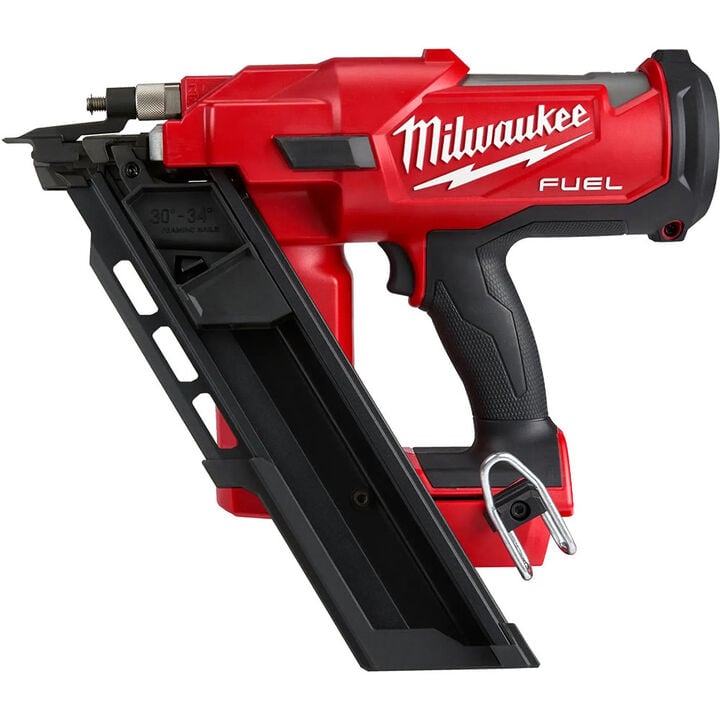
Milwaukee M18 FUEL 30 Degree Framing Nailer: Built for Heavy-Duty Construction
The Milwaukee M18 FUEL 30 Degree Framing Nailer is made for jobs that require large nails and serious driving power.
It uses a nitrogen spring mechanism, POWERSTATE brushless motor, and REDLINK Intelligence to deliver performance similar to a pneumatic framing nailer, without needing a compressor or air hose.
The framing nailer can drive full round-head nails into dense lumber and fires up to three nails per second with no ramp-up time. That means the tool is ready to fire as soon as you pull the trigger.
Best for:
- Framing walls
- Building decks
- Installing fences
- Constructing sheds
- Roof framing
- Working with engineered lumber
- Other structural projects
Helpful features:
- Fires up to three nails per second
- Zero ramp-up time
- Sequential and contact firing modes
- Tool-free depth adjustment
- Dry-fire lockout
- Rafter hook
- No-mar tip
- No gas cartridges required
- Onboard hex-key storage
This nailer is the better choice for contractors, remodelers, and serious DIY users working with large pieces of lumber and structural fasteners.
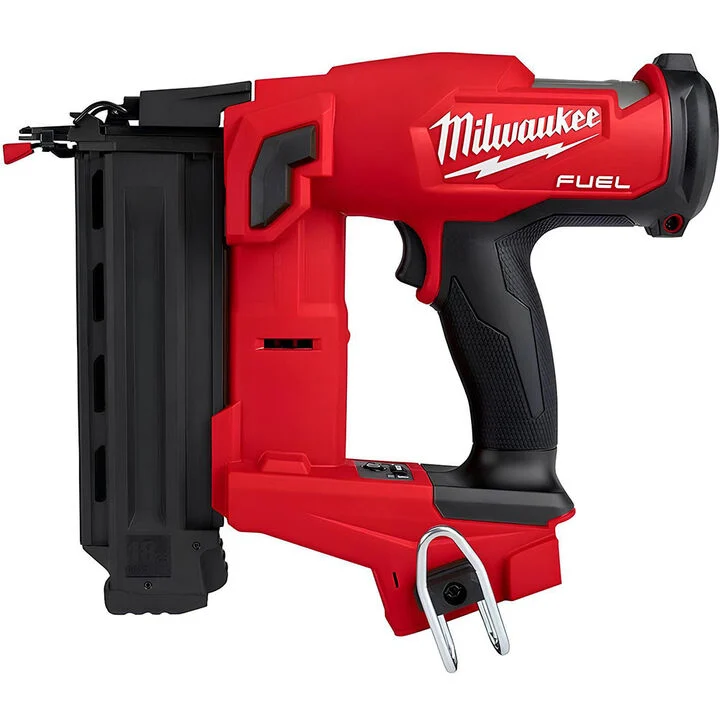
Milwaukee M18 FUEL 18 Gauge Brad Nailer: Designed for Clean Finish Work
The Milwaukee M18 FUEL 18 Gauge Brad Nailer is built for smaller nails and more detailed projects.
Brad nails are thin, so they leave behind smaller holes than framing nails. This makes the tool ideal for trim, molding, cabinets, and other projects where appearance matters.
The nailer uses a nitrogen air spring mechanism, POWERSTATE brushless motor, and REDLINK Plus Intelligence to consistently drive nails into both hard and soft wood. It also has zero ramp-up time, allowing it to fire immediately when the trigger is pulled.
Best for:
- Installing baseboards
- Attaching crown molding
- Installing window and door trim
- Cabinet work
- Furniture projects
- Decorative woodworking
- Light-duty fastening
Helpful features:
- Clean, consistent nail holes
- Compact and lightweight design
- Tool-free jam clearing
- Tool-free depth adjustment
- Sequential and contact firing modes
- Dry-fire lockout
- Zero ramp-up time
- Three interchangeable tips
- No gas cartridges required
The brad nailer is a strong option for finish carpenters, remodelers, woodworkers, and homeowners who want clean results without large nail holes.
Side-by-Side Comparison
Which Milwaukee Nailer Should You Choose?
Choose the M18 FUEL 30 Degree Framing Nailer when your project involves:
- Large nails
- Thick lumber
- Structural construction
- Framing, decking, fencing, or roofing
- High-volume fastening
Choose the M18 FUEL 18 Gauge Brad Nailer when your project involves:
- Small nails
- Detailed woodworking
- Trim and molding
- Cabinets or furniture
- A cleaner finished appearance
A simple way to remember the difference is:
- Framing nailer: Builds the structure.
- Brad nailer: Finishes the details.
Do You Need Both?
Professionals and serious remodelers may benefit from owning both tools because they handle different stages of a project.
For example, you could use:
- The framing nailer to build a wall.
- The brad nailer to install the trim after the wall is finished.
One cannot fully replace the other. A framing nailer is too powerful for delicate trim, while a brad nailer is not made for structural construction.
important battery information
Both products are sold as bare tools, meaning the battery and charger are not included.
They operate on Milwaukee’s M18 battery platform. These bare-tool options are ideal for users who already own compatible Milwaukee M18 batteries and chargers. New M18 users will need to purchase those items separately.
Real-World Scenarios
Building a Backyard Shed
Use the M18 FUEL 30 Degree Framing Nailer to assemble the floor, frame the walls, and build the roof structure. Its power is designed for driving larger framing nails into dimensional and engineered lumber.
After the shed is framed, use the M18 FUEL 18 Gauge Brad Nailer to install decorative trim, window casing, or lightweight interior panels.
Remodeling a Room
During a room remodel, the framing nailer can help:
- Build a new wall
- Frame a doorway
- Repair damaged framing
- Install structural blocking
Once the main construction is complete, the brad nailer can handle:
- Baseboards
- Window and door trim
- Crown molding
- Decorative wall molding
Building a Deck
The framing nailer is the more suitable choice for assembling many parts of a deck because it uses larger nails and offers greater driving power.
It can help with:
- Framing the deck structure
- Installing blocking
- Building stairs
- Completing other heavy-duty fastening tasks
The brad nailer is not intended for structural deck construction. It may still be useful for small decorative pieces, but brad nails should not replace approved structural fasteners.
Installing Kitchen Cabinets
The 18 Gauge Brad Nailer is generally the better choice for cabinet and finish work. It can temporarily hold trim, molding, and decorative panels in place while adhesive dries or additional fasteners are installed.
The framing nailer would be too powerful for most cabinet materials and could cause damage.
Framing a Wall and Installing Trim
This project shows why professionals often own both tools:
- Use the framing nailer to build and secure the wall frame.
- Install drywall and finish the wall.
- Use the brad nailer to attach baseboards and door trim.
The framing nailer builds the structure, while the brad nailer completes the finished appearance.
frequently asked questions
1. Can a brad nailer be used for framing?
No. An 18-gauge brad nailer uses thin nails designed for trim and light finish work. Brad nails do not provide the holding strength required for structural framing.
2. Can a framing nailer be used to install trim?
It is not recommended. Framing nails are much larger and can split trim, leave noticeable holes, or damage delicate materials. An 18-gauge brad nailer provides better control and cleaner results.
3. Do these Milwaukee nailers require an air compressor?
No. Both nailers use Milwaukee M18 batteries and sealed nitrogen spring systems. You do not need an air compressor, hose, or gas cartridge.
4. Do the battery and charger come with these nailers?
No. These models are sold as bare tools, meaning the battery and charger must be purchased separately. They are a convenient option for users who already own Milwaukee M18 batteries.
5. What is the difference between sequential and contact firing?
- Sequential firing: Requires you to press the nose against the material and then pull the trigger for each nail. It offers more control and accuracy.
- Contact firing: Allows faster repetitive nailing by holding the trigger and pressing the tool against the material.
Sequential mode is usually easier for precise placement, while contact mode is useful when speed is important.
shop more milwaukee products



0 Comments